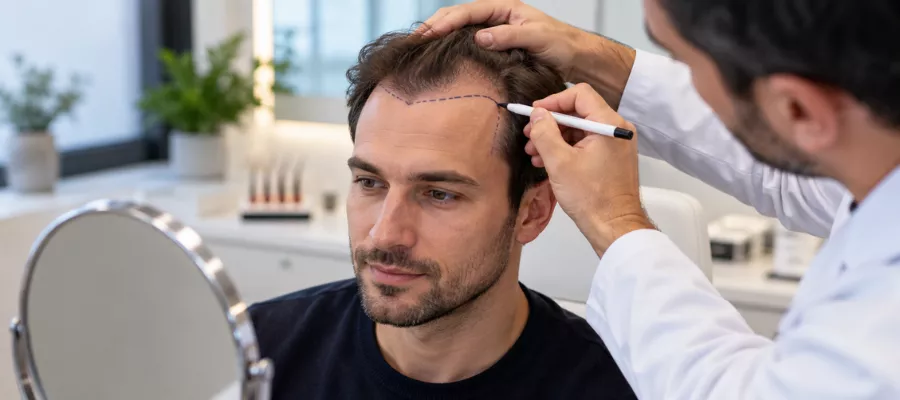
A natural hairline is designed before a hair transplant by studying facial proportions, age, existing hair, donor capacity, hair loss pattern, and likely future thinning. The aim is not to copy a standard shape or simply lower the forehead. A good design should frame the face, blend with surrounding hair, and still look appropriate years after the procedure.
This stage is completed before graft placement begins. During the initial assessment, hair loss, the donor area, hair structure, and expectations are reviewed before the most suitable approach is planned. Patients researching a hair transplant in Turkey should therefore pay as much attention to hairline planning as they do to the transplantation technique.
Why Is Hairline Design Important Before a Hair Transplant?
The frontal hairline frames the face, so even a technically successful transplant can look unnatural if its position or shape is poorly planned. A line that is too low may consume too many grafts. A line that is too straight can look artificial, especially when surrounding hair continues to thin with age.
Natural-looking results depend on balance rather than perfect symmetry. Small irregularities, gradual density, suitable angles, and an age-appropriate level usually create a softer transition. The design must also respect the available donor supply because those follicles are limited.
What Is Evaluated During the First Hairline Assessment?
Before a final line is drawn, the medical team reviews several details that influence appearance and graft planning.
- Forehead height, facial width, temples, and overall facial proportions are examined.
- Existing frontal hair and areas of miniaturization are assessed.
- Donor density, hair caliber, and usable graft capacity are reviewed.
- Hair texture, curl, color, and skin-to-hair contrast are considered.
- Age, family history, and likely progression of hair loss are discussed.
- Previous procedures, scars, and styling preferences are reviewed.
These details help determine whether the requested design is realistic. Two people with similar recession may still require different plans because their donor reserves, hair thickness, and long-term hair loss patterns can be very different.
How Are Facial Proportions Used to Design a Hairline?
Facial proportions provide reference points rather than a fixed formula. Forehead height, eyebrow position, temple shape, facial width, and the contour of the existing frontal zone are considered together. The objective is to create a frame that suits the individual rather than reproduce another person’s hairline.
| Feature | Why It Matters | Possible Effect on Design |
|---|---|---|
| Forehead height | Helps establish the frontal level | Influences how high or low the line begins |
| Temple shape | Affects lateral balance | Guides frontal corners |
| Facial width | Influences overall shape | Helps avoid an overly narrow or broad line |
| Existing hair | Provides natural reference points | Supports blending |
| Age | Affects long-term suitability | Encourages an age-appropriate position |
How Is the Right Hairline Height Chosen?
The lowest possible hairline is rarely the best option. Every additional area of coverage requires grafts, and lowering the line aggressively may reduce the number available for the mid-scalp or future procedures. A slightly more conservative position can create stronger visual density while preserving donor resources.
The proposed line is usually reviewed while the patient is sitting upright. Existing recession, forehead shape, and possible future loss are considered before approval. Patients should understand why a particular height has been recommended instead of choosing a position based only on younger photographs.
Why Is a Natural Hairline Slightly Irregular?
Natural hair does not grow in a perfectly straight row. The leading edge contains subtle variations in height, spacing, and direction. Reproducing this irregularity helps prevent the sharply drawn appearance associated with an artificial hairline.
Single-hair follicular units are generally better suited to the first transition zone because they create a softer edge. Stronger grafts can then be positioned behind them to build density. The goal is a gradual progression from fine frontal hairs to fuller coverage.
How Are Grafts Distributed in the Frontal Zone?
Hairline design includes more than drawing an outline. The team also decides where different graft types should be placed and which areas need the strongest visual density. The first millimeters usually need a delicate transition, while the central frontal zone can carry more coverage.
| Area | Main Objective | Planning Consideration |
|---|---|---|
| Leading edge | Soft transition | Fine single-hair grafts |
| Central frontal zone | Strong visual density | Balanced graft distribution |
| Frontal corners | Natural facial framing | Avoid overly square corners |
| Temple transition | Side-profile harmony | Precise direction and angle |
| Behind the hairline | Depth and fullness | Gradually increase density |
Hair caliber can change the visual effect significantly. Thick or wavy hair may create more apparent coverage than fine straight hair even with a similar graft count. This is why numbers alone do not determine the final appearance.
Why Do Angle and Direction Matter?
Transplanted hair should follow the natural flow of surrounding hair. At the front, hairs generally emerge at relatively acute angles rather than standing vertically from the scalp. Direction also changes toward the corners and temples.
If follicles are implanted at unsuitable angles, the hair may look unnatural or become difficult to style. Bosphoria Hair’s DHI Hair Transplant approach allows controlled placement of follicles, including their exit angle and direction. Technique can support precise placement, but careful planning remains essential.
Does the Hair Transplant Technique Change the Hairline Plan?
DHI, Sapphire FUE, and Manual FUE differ in extraction or implantation steps, but the main design principles remain similar. The hairline still needs to suit the face, donor area, existing hair, and anticipated future loss. Technique should support the treatment plan rather than dictate the shape.
Bosphoria Hair describes Sapphire Hair Transplant as using sapphire tips during recipient-channel creation, while Manual FUE Hair Transplant involves extracting follicles individually with manual micro-instruments. The most suitable method depends on the treatment area, donor characteristics, hair structure, and overall strategy.
How Is Future Hair Loss Considered?
A transplant should not be designed only for the patient’s current appearance. Native hair behind the transplanted area may continue to thin. If a very low frontal line is created without considering this progression, dense transplanted hair may later remain at the front while thinning increases behind it.
Age, family history, current recession, miniaturized hairs, and donor reserves are therefore evaluated together. A sustainable plan aims to leave enough donor capacity for possible future needs while keeping the current result balanced.
What Should Patients Check Before Approving the Design?
The marked hairline should be reviewed carefully before transplantation begins. Patients should understand why the line has been positioned at a particular level and how it relates to donor capacity.
- Ask how the proposed hairline matches your facial proportions and age.
- Ask how future hair loss could affect the result.
- Ask how many grafts are planned for the frontal area.
- Ask how single-hair grafts will be used at the leading edge.
- Ask how angles and growth direction will be controlled.
- Ask whether enough donor reserve will remain for possible future treatment.
Looking at comparable hair transplant before and after results can also help set realistic expectations. Examples are most useful when the degree of hair loss and hair characteristics are similar.
What Are Common Hairline Design Mistakes?
Some visible problems after transplantation are related to planning rather than graft growth. A low line may require too many follicles, while a rigid straight border can produce an artificial effect. Dense multi-hair grafts placed directly at the front can also create a coarse transition.
| Design Issue | Why It Can Look Unnatural | Planning Goal |
|---|---|---|
| Hairline placed too low | Uses more grafts | Choose a sustainable level |
| Perfectly straight border | Looks drawn or artificial | Introduce subtle irregularity |
| Square frontal corners | Creates a rigid frame | Follow natural recession |
| Wrong growth angle | Makes styling difficult | Match natural direction |
| Excessive frontal density | May reduce donor reserves | Balance present and future needs |
These issues are easier to prevent during planning than to correct later. Hairline design is therefore part of the procedure itself, not merely a cosmetic sketch before surgery.
Can the Hairline Be Adjusted on the Day of Surgery?
Yes. Minor adjustments can usually be made before implantation begins. The final drawing may be reviewed after the patient arrives and the scalp is examined again. Small changes in height, curvature, corners, or symmetry can be discussed before approval.
Once recipient sites and graft placement begin, changes become more complicated. Concerns should therefore be raised during the drawing stage so the patient and medical team share the same understanding of the planned result.