
DHI or Sapphire FUE: Which Should You Choose in Turkey?
If you are researching a hair transplant in Turkey, you will see two names everywhere: DHI and Sapphire FUE. Both start the same way — grafts are extracted one by one from the back of the head. The difference is how they are implanted.
- DHI (Direct Hair Implantation): grafts are loaded into Choi pens and implanted directly. Good for unshaven procedures, hairline detail and adding density between existing hair.
- Sapphire FUE: fine channels are opened with sapphire blades, then grafts are placed. Good for larger bald areas and big sessions.
Many patients get the best result from a combination. At Bosphoria Hair the technique does not change the package price, which starts at $2,750. Send your photos and we will recommend the right method for your case.
DHI Hair Transplant vs. FUE: Clearing Up the Biggest Misconception
When patients research dhi hair transplant vs fue, many clinic websites create confusion by presenting DHI and FUE as two completely unrelated surgeries. Here is the exact medical truth: both procedures use Follicular Unit Extraction (FUE) to harvest hair from the back of the head. The difference between a Sapphire Hair Transplant and a DHI Hair Transplant (Direct Hair Implantation) lies 100% in how the harvested follicles are implanted into the thinning area.
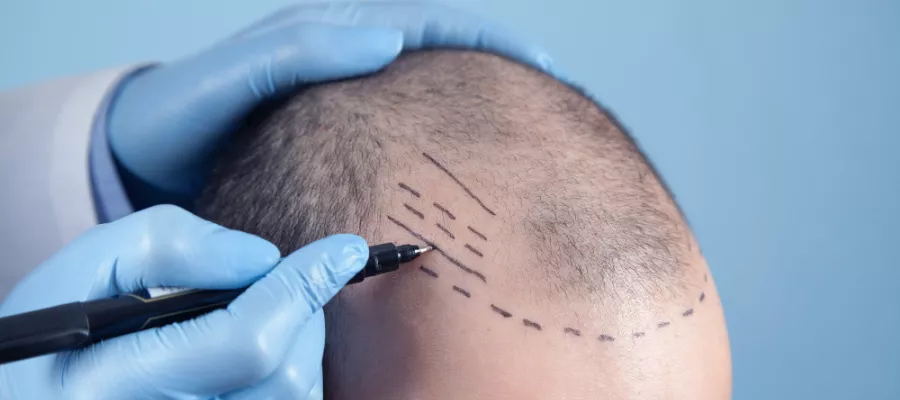
How Each Implantation Mechanism Works Anatomically
1. Sapphire Micro FUE (The Two-Step “Channel-Then-Place” Protocol)
After your donor grafts are harvested and stored at 4°C, Lead Specialist Muhammed Yeni uses a synthetic V-shaped sapphire crystal blade (1.0mm to 1.3mm) to open all micro-channels across the balding zone first. This allows the specialist to step back and visually verify the entire geometric blueprint, density gradient (up to 60–65 grafts/$cm^2$), and directional flow before the grafts are gently glided into the open V-channels.
2. DHI Direct Hair Implantation (The One-Step “Choi Pen” Protocol)
In a dhi hair transplant, no pre-made channels are opened in advance. Instead, surgical assistants load each individual graft into the hollow needle tip of a pen-shaped instrument called a Choi Implanter Pen (invented at Kyungpook National University). The specialist inserts the needle into the scalp at a 40° angle and presses the plunger—opening the micro-site and depositing the graft simultaneously in one motion.
| Clinical Scenario / Patient Profile | Best Technique Match | Why This Method Wins Clinically |
|---|---|---|
| Receding Hairline & Bare Temples (2,500–3,500 Grafts) | Sapphire Micro FUE or DHI | 1.0mm Sapphire blades and 0.6mm Choi Pens both achieve 60 FU/cm² framing. |
| Large Bald Areas: Norwood 4, 5, or 6 (4,000–5,000 Grafts) | Sapphire Micro FUE | Faster channel mapping keeps out-of-body graft ischemia time under 4 hours. |
| Diffuse Thinning Between Existing Native Hairs | DHI (Choi Implanter Pen) | Needle slips precisely between existing hair roots without cutting them (Thin Hair Guide). |
| No-Shave / Unshaven Procedure (Men & Women) | DHI (Choi Implanter Pen) | Zero requirement to shave the recipient scalp (Unshaven Hair Transplant). |
| Bare Frontal Hairline + Thinning Mid-Scalp/Crown | Hybrid (Sapphire FUE + DHI) | Combines Sapphire speed/density in front with DHI protection in the mid-scalp! |
Does DHI Cost More Than Sapphire FUE?
Because DHI requires 6 to 8 single-use Choi Implanter Pens per surgery and a larger team of microscope-trained nurses to load each pen in real time, US clinics routinely charge $17,000 to $24,000 for DHI (see our FUE Hair Transplant Cost audit). At Bosphoria Hair in Istanbul, our all-inclusive DHI and Hybrid packages remain between $2,750 and $3,490—so your surgical recommendation is based 100% on what is best for your hair, never on price markups.