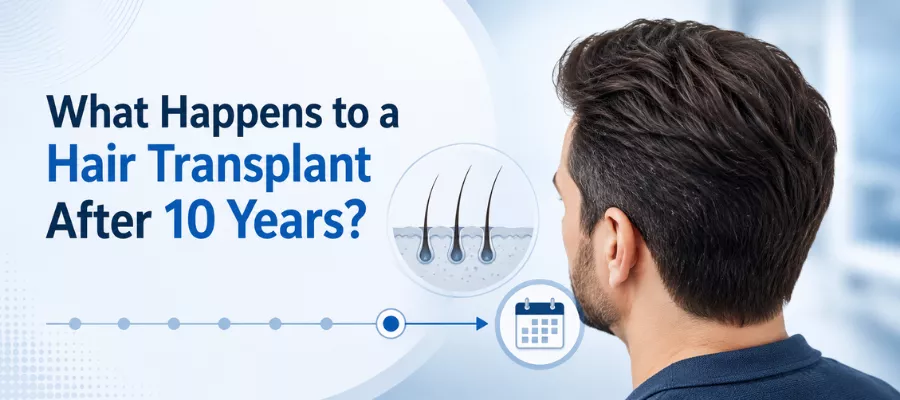
A hair transplant after 10 years can still look natural, dense, and well integrated with the rest of the hair. In fact, the follicles used during a transplant are generally taken from areas at the back or sides of the scalp where hair is more resistant to androgenetic hair loss. Once these follicles are successfully transplanted and established, they usually retain the characteristics of the donor area and continue producing hair in their new location.
That does not mean a hair transplant after 10 years will necessarily look identical to the result seen during the second or third year. A person’s scalp continues to change with age. Natural, non-transplanted hair can become thinner, the hairline may appear different as surrounding hair recedes, and individual strands can lose some thickness over time. The transplanted follicles may still be present and growing normally even when the overall appearance of the hair has changed.
Hair Transplant After 10 Years: Does Transplanted Hair Stay Permanent?
One of the main reasons people choose hair transplantation is its long-term potential. Modern hair transplantation relies on the principle known as donor dominance. In simple terms, follicles moved from a genetically resistant donor region tend to maintain their original characteristics after being placed in an area affected by hair loss. This is why a well-planned hair transplant after 10 years can continue to provide substantial coverage rather than disappearing after several years.
Still, the word “permanent” needs some context. Transplanted follicles are living tissue, and living hair naturally changes as a person gets older. Hair shafts may become finer, growth cycles can change, and the surrounding non-transplanted hair may continue to recede. Cleveland Clinic also notes that some patients can require additional or touch-up procedures to achieve or maintain a natural-looking result. Therefore, long-term success is better understood as lasting follicle growth rather than a guarantee that appearance will never change.
Hair Transplant After 10 Years: Common Changes in Long-Term Results
Looking at photographs taken immediately after a transplant and comparing them with the scalp ten years later can sometimes be misleading. The first major result of the procedure generally becomes visible after the transplanted follicles have completed their early growth cycle. The NHS states that full results are typically seen around 10 to 18 months after surgery. Everything that happens afterward should therefore be considered part of the long-term aging of the scalp rather than the original healing process.
A hair transplant after 10 years may show changes in density, texture, color, or the relationship between transplanted and native hair. Gray hair, for example, can alter the visual contrast between the scalp and the hair, while continued pattern hair loss may create thinner areas behind a previously transplanted hairline. These changes do not automatically indicate that the grafts have failed. In many cases, it is the untreated native hair that has changed most noticeably.
| Area | Possible Change After 10 Years | What It May Mean |
|---|---|---|
| Transplanted hair | Still growing but slightly finer | Normal long-term aging may play a role |
| Native hair | Further thinning or recession | Pattern hair loss may have progressed |
| Hairline | Still defined but less dense behind it | Surrounding hair may have weakened |
| Hair color | Increased gray or white hair | Natural aging rather than transplant failure |
| Overall density | Less visually dense than before | Can reflect several combined factors |
What Can Affect the Result?
No two long-term transplant results age in exactly the same way. Genetics remain one of the biggest influences because pattern baldness may continue in areas that were never transplanted. The quality and stability of the original donor area are also important. A surgeon generally plans transplantation with future hair loss in mind because concentrating too many grafts in one area without considering later thinning can create an unnatural contrast several years after the original operation.
Lifestyle and general health can also affect how hair looks over time, although sudden or significant new hair loss should not automatically be blamed on the transplant. Hair loss can have numerous causes, and the NHS notes that while hereditary male and female pattern hair loss can be permanent, other forms of shedding may be associated with medical conditions or temporary factors. A noticeable change in a hair transplant after 10 years should therefore be assessed in the context of the person’s overall scalp and health.
- Genetic hair-loss progression: Native hair around the transplanted area may continue to recede.
- Quality of the donor area: Strong, stable donor follicles generally support better long-term planning.
- Age-related changes: Hair can gradually become finer or change color with age.
- Health conditions: Some conditions may contribute to new or unexpected shedding.
- Original transplant design: Conservative graft placement can make future changes easier to manage.
- Ongoing hair care: Appropriate medical follow-up may help identify changes before they become visually significant.
Natural Hair Loss Around Transplanted Hair
One of the most important points to understand about a hair transplant after 10 years is the difference between transplanted hair and native hair. The follicles used for transplantation are generally selected from areas that are more resistant to androgenetic alopecia. Hair that was already growing naturally in the recipient area, however, has not gained this resistance simply because transplanted follicles were placed beside it. If genetically susceptible native follicles continue to miniaturize, the density surrounding the grafts can gradually decrease.
This explains why someone may still have a strong transplanted frontal hairline but notice thinning farther behind it several years later. The procedure itself may have worked exactly as intended, while the original hair-loss pattern continued to develop. Long-term planning is therefore particularly important for younger patients whose eventual degree of hair loss may not yet be obvious when they undergo their first procedure. A natural hair transplant after 10 years depends not only on graft survival but also on how well the original plan anticipated future change.
When Might a Second Procedure Be Needed?
A second procedure is not automatically necessary simply because ten years have passed. Many patients can remain satisfied with a single transplant for a long period, particularly when the donor area was strong and the initial procedure was designed conservatively. Cleveland Clinic notes, however, that some people may undergo touch-up transplant procedures to achieve a natural-looking result. The decision should be based on the current distribution of hair, donor availability, expectations, and progression of hair loss rather than the number of years alone.
For someone evaluating a hair transplant after 10 years, the most useful question is usually not “Has my transplant expired?” but “Has my overall hair-loss pattern changed?” Hair transplantation does not have a fixed expiration date. A further procedure may instead be considered when new areas have become thin enough to disturb the balance between previously transplanted hair and the rest of the scalp. A professional examination is particularly valuable before deciding whether additional grafts are appropriate.
- A previously untreated crown or mid-scalp area has become noticeably thinner.
- Native hair behind the transplanted hairline has continued to recede.
- Additional density is desired in an area that has gradually become sparse.
- The first procedure intentionally used a conservative number of grafts.
- The donor area still has sufficient suitable follicles for further transplantation.
- The patient’s current hair-loss pattern makes another procedure medically and aesthetically appropriate.
Maintaining a Natural Long-Term Appearance
The appearance of a hair transplant after 10 years depends heavily on whether the original transplant was designed for the future rather than just for an immediate transformation. A very low or excessively dense hairline may look attractive in the short term but can become harder to balance if significant hair loss develops behind it. A mature, proportionate hairline and careful use of the donor supply can provide greater flexibility as the scalp changes over the years.
Long-term follow-up can also help distinguish normal aging from a new hair-loss problem. Unexpected shedding, irritation, patchy loss, or a rapid change in density deserves medical assessment rather than assumptions about the transplanted follicles. Hair transplantation is generally considered a surgical procedure with potential risks, including the possibility that some transplanted hair may not take, so any unusual change should be evaluated individually.
| Long-Term Priority | Why It Matters |
|---|---|
| Realistic hairline planning | Helps the result remain age-appropriate |
| Conserving donor follicles | Preserves options if future treatment is required |
| Monitoring native hair | Reveals progression outside transplanted areas |
| Medical assessment of new shedding | Helps identify causes unrelated to the transplant |
| Individual follow-up | Allows decisions to reflect current hair and scalp condition |
The Long-Term Outlook
For most people considering the future of a hair transplant after 10 years, the central message is reassuring: transplanted follicles taken from an appropriate donor area are selected specifically for their ability to continue growing after relocation. This donor-dominance principle is fundamental to modern hair restoration surgery. Ten years passing does not suddenly cause those follicles to stop functioning, nor is there a specific point at which a successful transplant simply “wears off.”
What can change is the environment around those follicles. Aging, progressive hereditary hair loss, changes in native hair density, and individual health factors can all affect how the result appears when viewed as a whole. That is why a hair transplant after 10 years should be judged by more than graft survival alone. A thoughtfully planned transplant can continue to look natural many years later, while future thinning may sometimes require monitoring or additional treatment. The strongest long-term results usually come from realistic expectations, careful donor management, and a plan designed to age naturally with the patient.