What Is an FUE Hair Transplant?
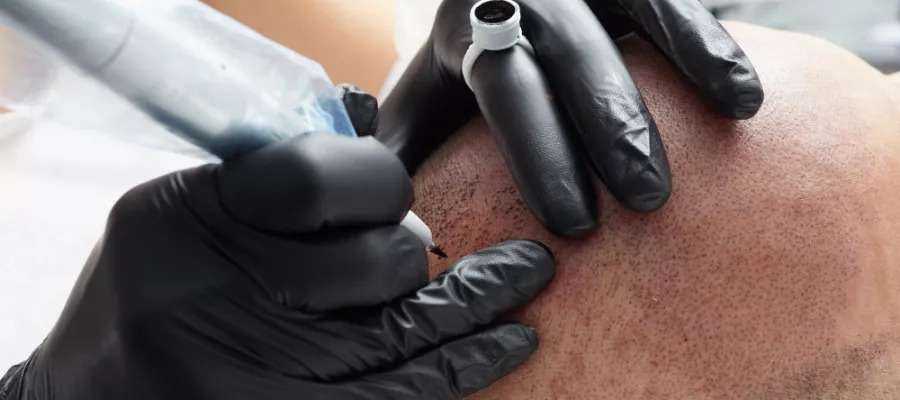
An fue hair transplant (Follicular Unit Extraction / Excision) is the modern micro-surgical gold standard for permanent hair restoration. Instead of cutting away a large strip of scalp skin with a scalpel, FUE harvests individual follicular units—naturally occurring groupings of 1, 2, 3, or 4 hairs—directly from the back and sides of the head using hollow cylindrical micro-punches measuring just 0.65mm to 0.75mm in diameter.
At Bosphoria Hair in Istanbul, we elevate standard FUE through two advanced clinical modalities: Sapphire Hair Transplant (using V-shaped synthetic sapphire crystal blades to open ultra-dense recipient channels) and Manual FUE Hair Transplant (hand-oscillated tactile extraction). To see how FUE pricing compares between America and Istanbul, read our FUE Hair Transplant Cost & Price Per Graft guide.
FUE vs. FUT Hair Transplant: Complete 2026 Clinical Comparison
When patients research fue vs fut hair transplant options in the United States, they often encounter older domestic surgeons who still defend FUT (Follicular Unit Transplantation, commonly called “strip surgery”). Let us examine the anatomical differences between the two procedures:
| Comparison Factor | FUT (“Strip Surgery”) | Modern Sapphire / Manual FUE |
|---|---|---|
| Surgical Incision in Donor Area | 18cm to 25cm full-thickness scalpel excision down to fascia | Microscopic 0.65mm–0.75mm superficial dermal scoring |
| Wound Closure | 30 to 50 metal surgical staples or deep nylon sutures | Self-healing pinpoint sites (closes in 48 hours without stitches) |
| Long-Term Donor Appearance | Permanent horizontal linear scar (stretches if scalp is tight) | Homogeneous, invisible micro-dots (wear #1 or #2 fade haircuts) |
| Follicular Survival Rate (2026) | Good | high (with 4°C hypothermic storage & Sapphire blades) |
| Physical Exercise Restriction | 4 to 6 weeks (heavy lifting stretches the strip scar) | Resume light workouts in 10–14 days |
Busting the Old Myth: Does FUT Really Have Higher Graft Survival Than FUE?
Twenty years ago (in the early 2000s), when early FUE pioneers used blunt 1.2mm punches, strip surgeons claimed that FUT yielded better graft survival. In 2026, peer-reviewed studies from the International Society of Hair Restoration Surgery (ISHRS) report that modern fue hair transplant survival equals or exceeds FUT (high survival) when three clinical protocols are followed:
- Trivellini / Torque-Controlled Micro-Punches: Our team aligns the punch angle precisely with the subcutaneous follicle curve, keeping follicular transection (damage) below 1.8%.
- Selective “Cherry-Picking” of Grafts: In FUT strip surgery, you only get the hairs inside the narrow 1.5cm strip cut from the mid-occiput—which are often too coarse for the front hairline. In FUE, Specialist Muhammed Yeni selectively harvests finer single-hair follicles from the lower nape to build a soft frontal transition zone, and harvests thick 3-hair and 4-hair units from the dense occipital core for mid-scalp bulk.
- Zero Suture Tension Ischemia: Pulling the scalp tight to staple an FUT strip closed reduces blood flow along the suture line and frequently causes temporary or permanent occipital nerve numbness. FUE helps preserve the deep neurovascular bundles.
Should You Choose Sapphire FUE or DHI?
Once you rule out outdated FUT strip surgery, your next clinical decision is how your FUE-harvested follicles should be implanted: via V-shaped Sapphire micro-channels or via Choi Implanter Pens (DHI Hair Transplant). Be sure to read our companion guide on DHI Hair Transplant vs. Sapphire FUE to see how we match each method—or combine both in a Hybrid session—to your exact hair loss stage.